

Written by Rev
Before reading this article, I highly recommend reading my article “The Political Economy of Barbarism”, as the concepts used here are further explained and established there.
INTRODUCTION
Libertarians have long presented themselves as the foremost authorities on inflation. Whenever prices rise, they quickly offer the usual explanation, that government spending, excessive money creation, and state interference in the economy. According to them, inflation is fundamentally a monetary phenomenon, and its cause can almost always be traced back to the government’s inability to restrain itself. They typically argue that we must therefore restrain the government’s ability by downsizing government and, by extension, its authority over the economy.
The appeal of this explanation becomes easier to understand when we consider the weakness of the alternatives generally offered by the conventional left. When confronted with rising prices, many leftists resort to the familiar explanation that inflation is simply the result of corporate greed, price gouging, or businesses taking advantage of consumers. While there may be some truth to this, it is nearly impossible to turn it into a scientific theory because it rests heavily on the psychology of capitalists and politicians. “Capitalists are just greedy” doesn’t actually tell us very much about the nature of why capitalism, as a mode of production, must, by its very nature, necessitate inflation. This weakness in the conventional left’s explanation has helped lend libertarians an undeserved authority over the subject. When the left cannot offer anything beyond accusing corporations of greed, libertarians can present themselves as the only people willing to discuss money, currency depreciation, credit, and monetary policy. For this reason, libertarians can portray their own explanation as a serious economic analysis and critique of the state.
It was Marx, not the libertarians, who developed a rigorous scientific theory that allows us to critique the state’s role in inflation. Libertarians are generally on the right track in identifying the state as central, yet they fundamentally misunderstand both the nature of the state and the nature of inflation under capitalism. Once that misunderstanding is cleared away, it becomes clear that Communists, not libertarians, are the real theoretical authorities on the relation between the state and inflation.
The Shared Blind Spot of Mises and Heinrich

At first, Ludwig von Mises and Michael Heinrich might seem like two people who have very little in common. Mises was one of the leading figures of the Austrian School and a committed defender of the free market. Heinrich, on the other hand, is a prominent Marxist theorist and one of the better-known figures associated with the so-called “Neue Marx-Lektüre”, a current of Marxist thought that emerged in West Germany during the late 1960s and 1970s.
The origins of this current can be traced to figures such as Hans-Georg Backhaus and Helmut Reichelt, whose work was heavily influenced by Adorno and the Frankfurt School. Their central concern was that traditional Marxism had misunderstood Marx’s theory of value. In particular, they challenged the idea that value exists as a substance already contained within commodities during production, as though a definite quantity of labor were embedded in them and later expressed through money. Instead, they shifted attention toward the value-form itself and the role money plays in establishing value as a social relation. Heinrich is best known for this approach, rejecting what he calls the “substantialist” interpretation of Marx, which treats value as fully established in production before it enters circulation.
Despite their opposing political commitments, Mises and Heinrich share an important limitation in how they approach monetary phenomena. Both give considerable explanatory weight to money and circulation, leaving the organization of production and the expenditure of labor-time outside the center of their analysis.
Mises makes his position quite clear:
“Inflation, as this term was always used everywhere and especially in this country, means increasing the quantity of money and bank notes in circulation and the quantity of bank deposits subject to check.” [1]
Heinrich arrives at a somewhat comparable position from an entirely different direction. Through his monetary theory of value, he argues that value is not something already present in commodities as a fully formed substance before they enter exchange. In the traditional, “substantialist” reading of Marx that Heinrich rejects, value is understood as a quantity of abstract labor already objectified in the commodity during the production process, a magnitude that is later merely expressed in money. Heinrich insists that this view is mistaken. Value, for him, is not a pre-given property of the individual commodity, but rather, its social validity depends entirely on the monetary form and on the relations through which commodities are exchanged. Value, Heinrich says, only obtains objective social validity and is measurable in the act of exchange itself. Before exchange, products of labor do not yet possess an objectively established magnitude of value, even though the value relation itself is not simply created by the exchange act. Only when they are set into relation with one another through money do they acquire the social property of value. For Heinrich, money is not a secondary expression of a magnitude already determined in production, but rather it is constitutive of value. For him, without money and without the exchange relation, there is no value in the proper sense of the term.
This has direct consequences for how price and inflation must be understood. If value obtains objective social validity through exchange, then its magnitude cannot be fully determined independently of the monetary relations through which privately expended labor is socially validated. Price is therefore not simply the monetary expression of a value whose magnitude was already definitively established in production, but the monetary form through which value acquires an objectively determinate magnitude. This does not mean that price and value are identical, but that their relationship cannot be understood independently of the monetary form.
This understanding of value also determines how movements in the general price level are approached. If value acquires its objective form through monetary exchange, then changes in prices necessarily become questions of circulation and the monetary relations through which commodities are validated. Inflation appears as a monetary phenomenon belonging to circulation, a question of the quantity of money, the relations of exchange, and the form in which value is validated. Production consequently loses its position as the starting point of the explanation. The labor process may affect the conditions under which commodities enter exchange, but the underlying determination of prices is ultimately sought in the monetary relations through which their value is established.
But this is where Heinrich’s argument runs into a serious problem. If objective social validity is established through the monetary form, then the theory must still explain how that form distinguishes labor expended on a product that possesses use-value from labor expended on one that does not. A successful sale, by itself, cannot settle the question. In other words, the very act of exchange becomes what confirms that a commodity contains value. The problem is that this runs against one of Marx’s most basic arguments, that being, not all labor produces value. A point of emphasis so essential for Marx that he made sure to put it in the very first chapter of Capital, Volume 1:
“Lastly nothing can have value, without being an object of utility. If the thing is useless, so is the labour contained in it; the labour does not count as labour, and therefore creates no value.” [2]
And the historical record proves Marx on this point. As I showed in my essay on Barbarism, titled “The Political Economy of Barbarism” [3], the Agricultural Adjustment Act (AAA) of 1933 provides a particularly striking case. Under the AAA, the government actually paid farmers to destroy crops, leave fields unused, and slaughter livestock. These were products for which there was no market demand, and hence they could not be sold. They had no use for anyone, and in the most literal sense, they possessed no use-value. And yet they were still assigned a price and exchanged for government fiat money.
So think about what this means. The crops were in excess because no one wanted them, and so they had no social usefulness. But according to Marx, labor expended on an object without use-value creates no value. The AAA payments, however, treated these useless products as if they were value-bearing commodities, paid for in a “currency” which itself contains no value, because it contains no socially necessary labor time. Essentially, it has no cost of production.
Heinrich's position creates an obvious difficulty here, because if value acquires its objective existence through monetary exchange, then the government's purchase of these products should be sufficient to establish their value, regardless of whether their production contributed anything useful to society. Under his criterion that locates objective social validity exclusively in the monetary relation, the sale itself appears to settle whether the labor counted as value-producing. But as I show, Marx's distinction between use-value and value rules out this conclusion, because the payment of money cannot turn an object that serves no social purpose into a bearer of value, since the expenditure of labor on something useless does not count as value-producing labor in the first place. The AAA demonstrates the point in the clearest possible way, because exchange occurred, money was transferred, and yet no value was created. In short, the monetary form simply disguised the absence of value-creating labor.
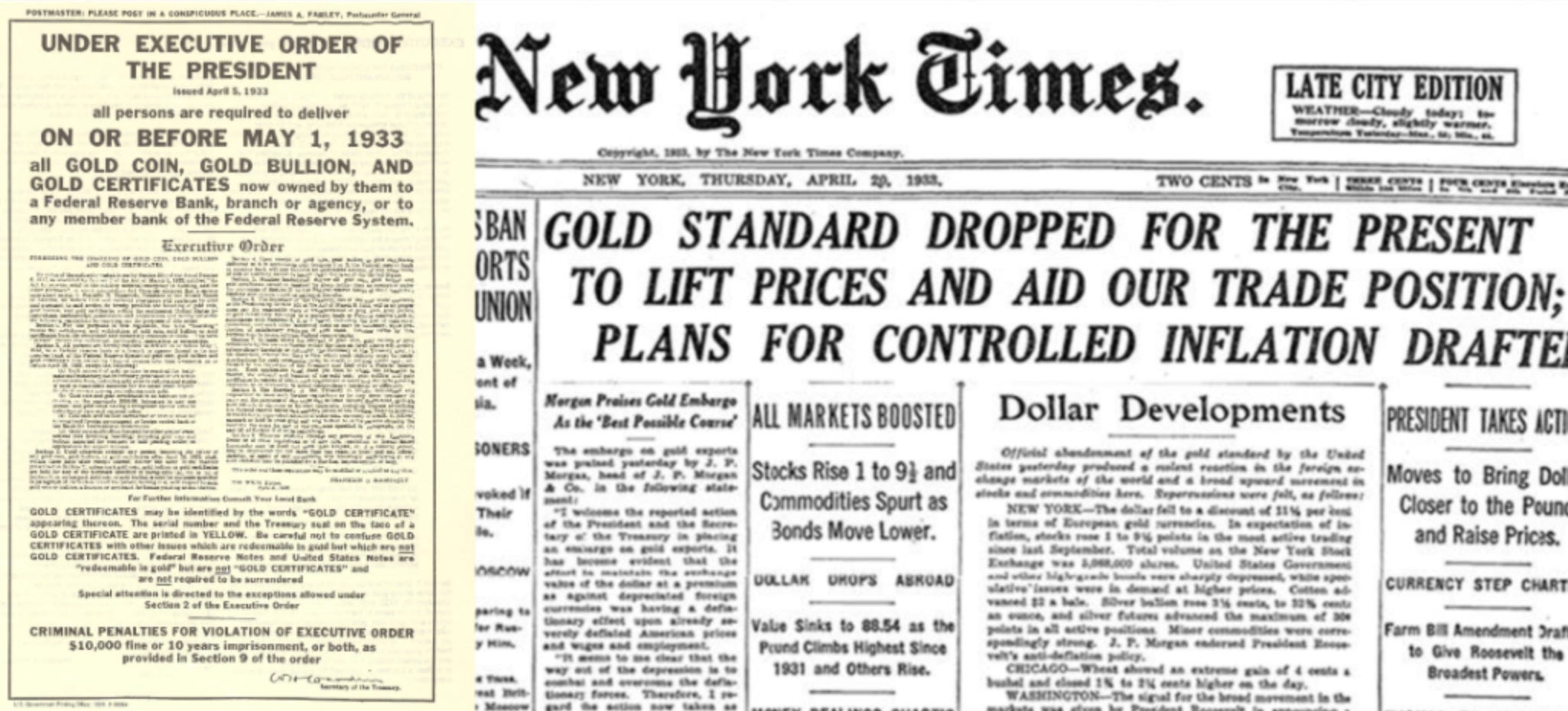
So Heinrich’s revisionism reaches a clear limit, because once objective social validity is located exclusively in the monetary relation, the theory can no longer clearly distinguish between products that possess use-value and those that do not. As a result, it also loses the ability to distinguish value-creating labor from superfluous labor-time. Heinrich plays into the hands of the fascist state, because the fascist state and its puppet economists rely on this very confusion in their disgusting and parasitic attempts to continue justifying the immiseration of the working class. Once the gold standard is abandoned and the currency becomes pure fiat (1933), the state can expand the money supply at will and assign dollar prices to virtually anything. GDP then becomes the official measure of economic “health”, but GDP is nothing more than the sum of final purchases denominated in those same dollars. Bourgeois economists count every monetary transaction as if it represented the creation of new value because they have no proper theory of value. So then, finance, insurance, real estate, professional services, government spending, and the entire sphere of circulation are added together with, say, manufacturing and agriculture as if they were equivalent. The result is a statistical fiction that systematically inflates the appearance, and I say real emphasis on appearance, of production, while concealing its real underlying contraction, its roots, its essence, its foundation, its substance. In reality, the sectors that produce new value through living abstract labor, transforming nature into useful products, have steadily shrunk as a share of the overall economy. Manufacturing, the bare-bones revolutionary proletarian subject for Marx, is perhaps the clearest example of this decline, while at the same time, sectors concerned with circulation, administration, and the destruction of value have continued to grow. The state’s fascist dollar-based accounting system, along with GDP, purposely helps conceal this distinction. Government spending, financial transactions, and even in our example of payments to farmers for destroying crops all show up as “economic activity.” Activities that produce no new value are therefore counted alongside actual production, making the economy appear to be “growing” even as an increasing amount of labor-time becomes superfluous.
So, where does inflation come from?
Here the argument returns to its starting point, because the same confusion is what allows libertarians to present themselves as the serious theorists of inflation. Because they, like Heinrich, remain trapped within the horizon of exchange and money, they can only see inflation as a monetary phenomenon, typically saying it is an excessive increase in the quantity of money and credit. For Mises and his followers, the cause is always the state “printing” too much money, and their solutions typically follow along the lines of “we must restrain the state and return to sound money.” But what never appears in their analysis is the possibility that the continuous expansion of the money supply is not an arbitrary policy error, but a necessary response to a contradiction already present in production, the necessity for capital to expand credit and to endlessly expand and foster the existence of superfluous labor time.
The argument can now be stated more precisely: inflation, in the simplest terms, is a change in the relationships between prices and value caused by expansion of labor that produces no value.
This is where the argument breaks from the Austrian school and other theories that treat exchange as the starting point of inflation, because the problem does not begin at the point of sale but in the relations of production themselves. Too much labor is being devoted to activities that produce no new value, as capital continues to employ workers even when their labor adds nothing to the total social product or produces goods and services that cannot be sold and realized as value. The same problem exists on an even larger scale with the state, which consumes enormous amounts of labor, capital, and resources through expenditures that do not expand productive output. Rather than contributing to the creation of new value, this growing mass of unproductive expenditure places an increasing burden on the economy and contributes to the inflationary pressures that follow.
In the simplest mathematical terms, the relation can be stated as follows.
The normal capitalist circuit is:
M ⟶ C (LP+MP) ⟶ P ⟶ C′ ⟶ M′
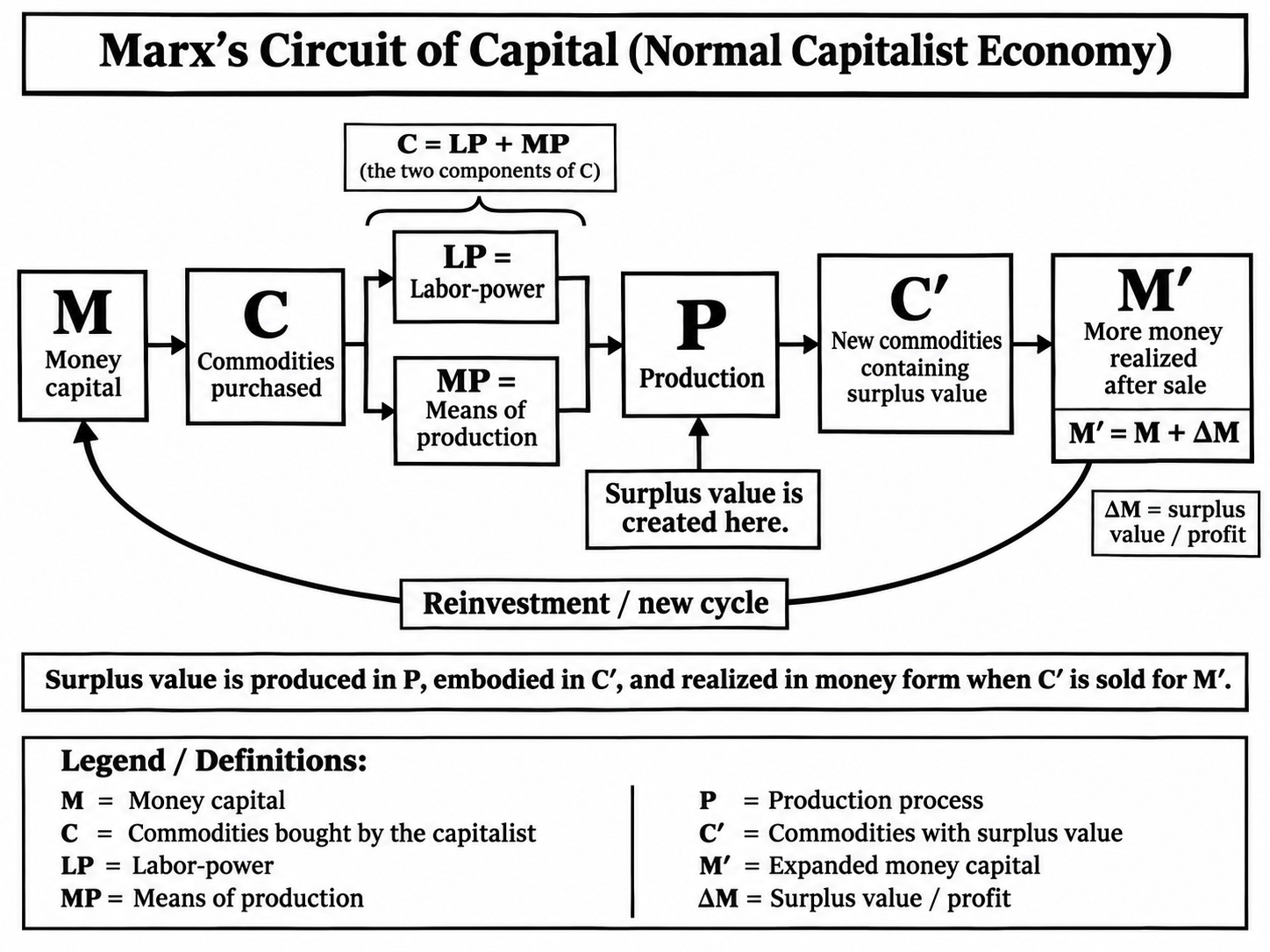
New value is created only when living labor produces a use-value that can be realized as value. Let (𝑣️) = value of labor-power and (s) = surplus-value.
Total new value = 𝑣️ + s, but only if a real commodity (C’) results.
When labor is productively employed, the circuit of capital functions as expected, where money is advanced to purchase labor-power, workers produce use-values, and new value (𝑣️+s) is added to the total social product. The wages paid out are accompanied by a corresponding addition to the mass of values, keeping the relationship between money in circulation and the value of commodities grounded in the labor actually performed. Under these conditions, labor contributes to the production of social wealth rather than creating an imbalance between money and value.
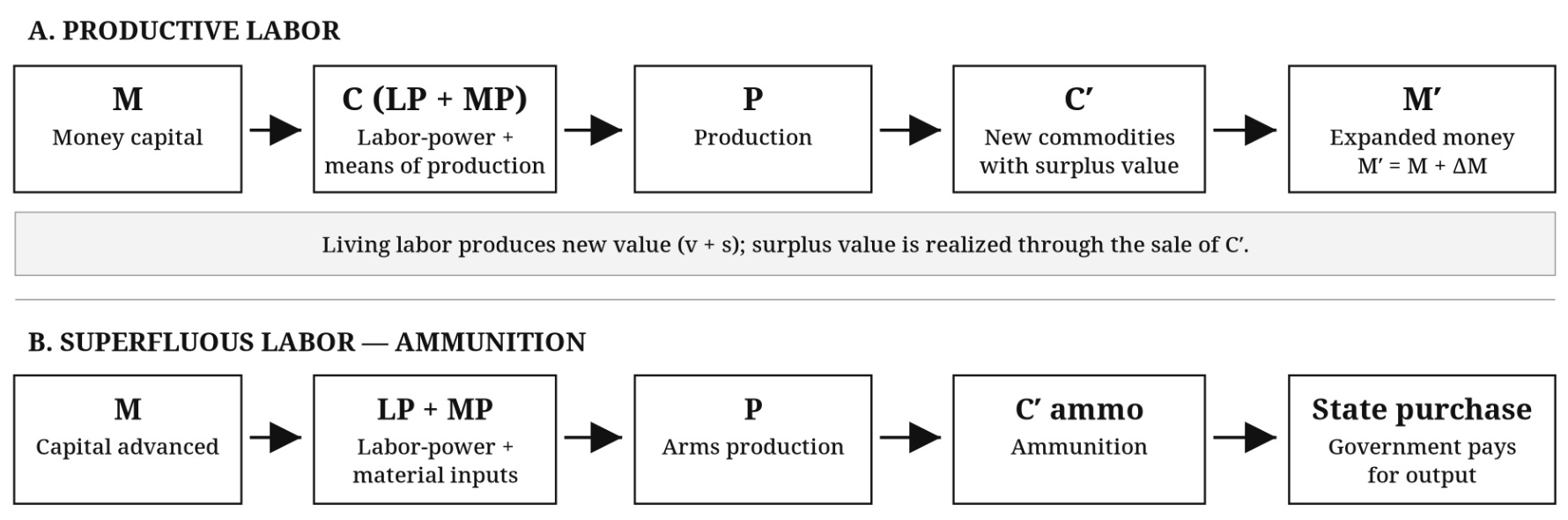
The situation changes when labor becomes superfluous. Let us illustrate this through the production of military ammunition, where labor-power is purchased, wages are paid, and raw materials are consumed to produce a finished commodity that contributes nothing to social reproduction. Although something has been physically produced, its existence alone does not make it a bearer of value, because without a socially recognized use-value, it cannot possess value in the Marxian sense. It is only given a price and a market because the government is artificially circulating and expanding this superfluous labor as a buyer, so they can go kill random people overseas for the hell of it.
Let us examine this in an instance where the government buys ammo.
Therefore:
MLP ⟶ Labor ⟶ C'ₐₘₘₒ (C′ has no use-value)
Because the object is useless, the labor contained in it “does not count as labor” in the value-creating sense, and so new value created = 0.
The money advanced to purchase this labor-power still enters circulation, meaning that additional purchasing power is introduced into the economy without any corresponding increase in the mass of values. To put this in simple terms, let Mₜₒₜₐₗ be the existing quantity of money and Vₜₒₜₐₗ the existing total value of commodities that actually possess use-value.
After the superfluous labor is performed:

The ratio must rise:

Math isn’t everyone’s thing, so I will explain it in VERY simple terms to demonstrate why inflation rises because of superfluous labor.
Suppose, before the superfluous labor to produce ammo for the U.S. army is worked:
Total money = 100
Total useful stuff = 100
Ratio = 100/100 = 1
Now add the superfluous labor that produces ammo for the U.S. Army, which puts 10 extra money into the economy but adds 0 useful stuff:
New total money = 100 + 10 = 110
New total useful stuff = 100 + 0 = 100
New ratio = 110/100 = 1.1
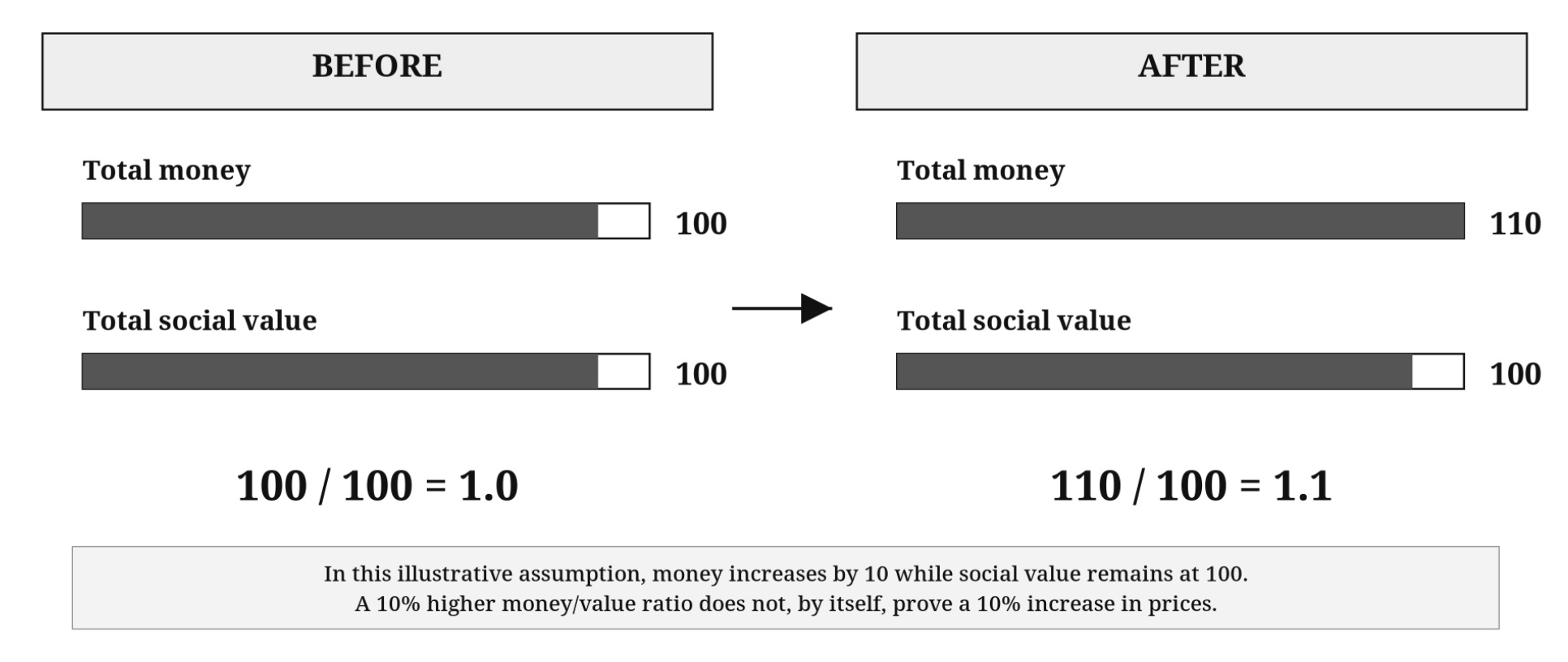
1.1 is bigger than 1, so the ratio rose. It means there is now more money sitting on top of the same amount of useful stuff. It is important to understand, though, that the rise in the money-to-value ratio does not mean that every price increases immediately or by the same amount, since money can temporarily remain in reserves, be used to repay debt, or circulate through financial markets rather than being spent directly on commodities. The numerical example is only a simplified thought experiment intended to isolate the underlying relationship, rather than claim that every real-world episode of inflation unfolds in precisely the same way or at the same speed. What it demonstrates is that the relationship between the total purchasing power circulating through the economy and the mass of values it represents has been altered, creating a persistent pressure that gradually expresses itself in a higher general price level, while countervailing tendencies pressure wages to stagnate and be maintained below their value. The effects may be delayed or uneven, but the underlying divergence continues to widen as additional purchasing power enters circulation without a corresponding increase in the mass of value.
This same process extends across the economy as a whole, as the purchase of labor-power that produces no additional use-value contributes to a growing divergence between the total amount of money in circulation and the mass of value being produced, a process that operates through five interconnected channels.
The first channel is the expansion of the money supply without a corresponding increase in the mass of values being produced. When the state purchases surplus corn, military ammunition, or other products of labor that contribute nothing to the production of social wealth, it still pays out money that enters circulation, even though these expenditures add no new value to the total social product. In the numerical example, spending ten additional units on ammunition increases the total money supply from 100 to 110, while the stock of useful commodities remains unchanged at 100. The same imbalance develops whenever large amounts of otherwise idle labor-power are purchased and employed in activities that produce no additional value, since wages and other expenditures continue to put money into circulation without adding anything to the mass of values. So money is increasing, but value does not, meaning that the amount of money circulating in relation to the value of useful commodities steadily rises. This is typically what libertarian types mean by “too much money chasing too few goods”, but in more scientific terms, it is too much money chasing too much superfluous labor.
The second channel operates through the creation of prices for products and services that possess no value in the Marxian sense. Surplus corn that cannot find a buyer, ammunition that serves no productive social purpose, and administrative services that merely circulate existing claims are all assigned dollar prices despite contributing nothing to the production of new value. These prices are not expressions of the abstract labor embodied in useful commodities, but exist because the state is willing to purchase these products and services regardless of their contribution to social production. Since the labor expended on them does not count as value-producing labor, the prices attached to these expenditures have no corresponding foundation in value or the socially necessary material sphere of production. This creates a growing distortion in the relationship between prices and values, which does not remain confined to the superfluous products themselves but extends into the wider economy, where prices increasingly cease to reflect the actual value being produced.
The third channel concerns how the additional purchasing power generated through superfluous labor eventually feeds back into the prices of commodities that do possess use-value. Workers who receive wages for producing ammunition or destroying crops still need to buy food, pay rent, purchase clothing, and cover their other living expenses, so the money paid out for labor that produces no additional value eventually finds its way into the market for useful commodities, placing upward pressure on their prices even though their underlying values have not increased.
This is not simply a matter of domestic redistribution, but the domestic expression of a much larger imperial arrangement. As an increasing share of the American labor force becomes employed in activities that produce no new value, military production, finance, insurance, real estate, administration, and other forms of pure service labor, the United States becomes increasingly unable to reproduce itself based on its own value-creating productive labor. Yet the wages paid to workers in these sectors still generate effective demand, and that demand must ultimately be satisfied by actual use-values, from food, oil, manufactured goods, and raw materials. To the extent that these goods are no longer produced in sufficient quantities domestically, they must be imported.
In 2023, only 52 percent of the value of gross domestic purchases consisted of pure domestic content, while the remaining 48 percent came from imported final goods (37 percent) and imported inputs incorporated into domestic output (11 percent). Even under the more generous measure of domestically produced output, only 63 percent of purchases were classified as domestic, leaving 37 percent accounted for by imported final goods. The dependence is even more pronounced in manufacturing, where the purely U.S.-made value content of domestically purchased manufactured goods is only 52 percent, meaning nearly half of the value of manufactured use-values satisfying domestic demand originates abroad.
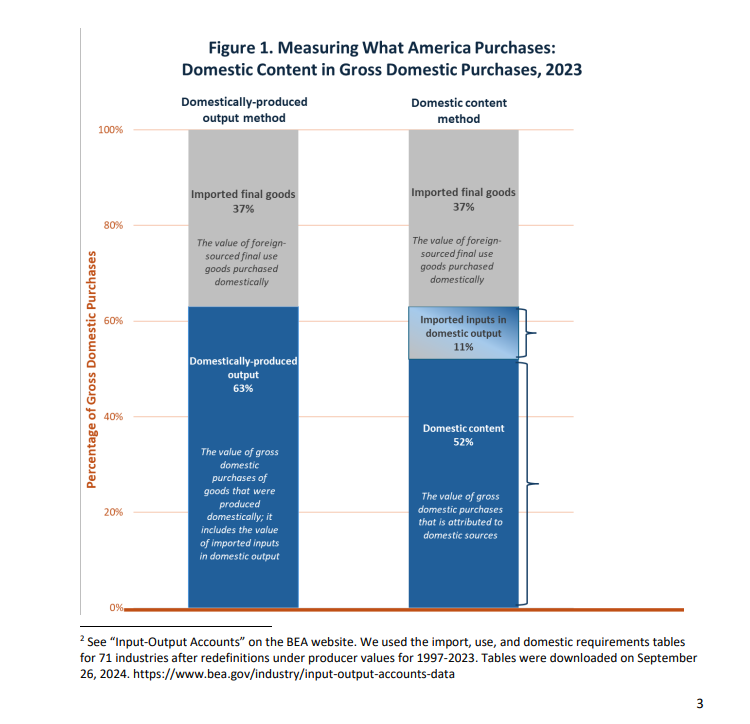
This dependence provides the material basis for the service and permanent war economy. As the domestic labor force increasingly shifts into activities that do not produce new value, the wages paid to these workers continue to generate demand for goods whose production increasingly takes place outside the United States. That demand is met through the appropriation of value produced by living labor abroad, as foreign producers supply the food, energy, manufactured goods, and raw materials required to sustain domestic consumption. The continuous inflow of these imports, purchased with dollars issued through the monetization of domestic superfluous labor, helps moderate immediate inflationary pressure at home while shifting part of the material burden onto foreign producers. The United States supplies dollar-denominated claims, including Treasury securities, sustained by the continued expansion and international circulation of its fiat currency, while the rest of the world supplies the actual use-values.
Without this external supply of goods, the upward pressure on the prices of useful commodities generated by the purchasing power of superfluous labor would become more immediate and difficult to contain. Super-imperialism, as Michael Hudson calls it, so becomes the international mechanism through which the United States sustains the domestic production of superfluity while securing the material goods needed to reproduce its economy. The United States has chosen a merry life and a short one, living by plundering the world, enjoying the proceeds of extraction while knowing the arrangement cannot last indefinitely. As with all empires, those who live by the sword will die by the sword due to its own underlying contradictions. The same dollar mechanism that allows the United States to import use-values produced abroad also tends to require the continuous expansion of employment in other countries simply to meet the demand generated by domestic superfluous labor, but this international side of the process will have to be examined separately, as global trade is a whole different ball game of investigation.
The inflationary pressure, hence, cannot be understood simply as a matter of demand exceeding the available supply of goods. It must also account for the additional purchasing power introduced into circulation through the payment of wages for labor that, within this framework, contributes nothing to the mass of social value. More money is consequently placed in circulation against the same underlying mass of useful commodities, gradually diminishing the purchasing power of each dollar. U.S. military spending, for example, estimated at roughly $900–975 billion, or 3.1–3.4 percent of GDP [5, 6], and an aerospace and defense industry supporting more than 2.1 million jobs at average wages of $112,000–127,000 [7, 8], illustrate the scale of purchasing power generated by this expenditure. So wages are paid, we see that incomes are being created, and demand enters the economy even though, according to the argument developed by me, the resulting military output adds nothing to the mass of social value. The same process operates on the production side, since firms receiving government contracts for ammunition, weapons systems, and other products of superfluous labor must still purchase the steel, copper, energy, chemicals, and other raw materials required to fulfill those contracts. Whatever the character of the finished products, the resources consumed in their manufacture are materially real and must be withdrawn from the available supply of materials that could otherwise be used in socially useful production. Defense-related copper demand alone has reached approximately 141,000 metric tons annually, while historical estimates put Department of Defense copper consumption at 106,000 tons in a single year [9, 10]. Military platforms such as aircraft carriers also require tens of thousands of tons of steel [11]. Every ton of copper, steel, and other material committed to this production is then unavailable for the manufacture of useful commodities, meaning that superfluous production not only introduces additional purchasing power into circulation but also places further constraints on the material resources available for productive social reproductive activity.
The trend continues into the sphere of manufacturing, whose share of nominal GDP has fallen from roughly 25 percent in the mid-twentieth century to around 10 percent today [12, 13].
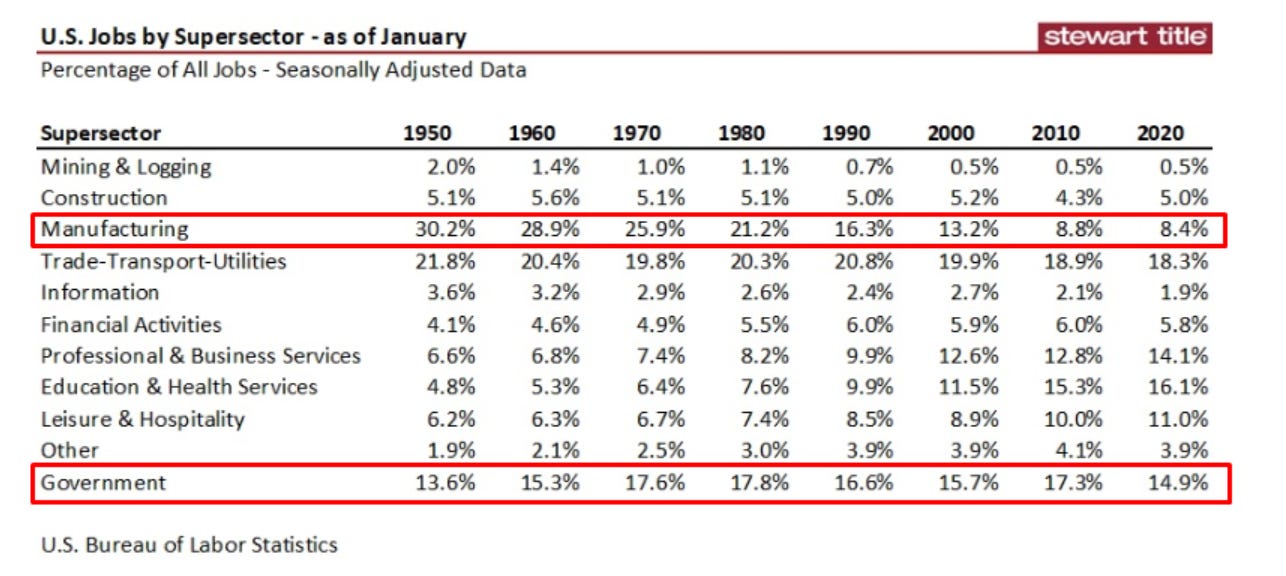
So then, superfluous production affects the relationship between money and value in both directions, because it introduces additional purchasing power into circulation without adding to the mass of social value, while simultaneously consuming the labor, raw materials, and other resources that could otherwise be used to produce additional use-values. As more labor and material wealth are diverted into this kind of production, fewer resources remain available for useful production, placing increasing pressure on the supply of useful commodities while widening the divergence between the money circulating in the economy and the value being produced.
The fourth channel is the decline in the real value of labor-power as rising prices steadily destroy workers’ wages and the extension of the working day places further downward pressure on their compensation. Because wages are generally fixed through contracts and tend to adjust more slowly than the cost of living, workers find that their income buys less even when their nominal wages remain unchanged. In Marxist terms, this represents a decline in the real value of variable capital (v) relative to the money paid out in wages, since workers can purchase fewer of the necessities required to reproduce their labor-power with the same amount of currency. The gap between the money advanced to purchase labor-power and the value that labor actually contributes to production becomes increasingly pronounced, particularly in sectors where the labor performed produces no additional value to begin with. This erosion is reinforced by the same conditions that produce superfluous labor in the first place, namely the continuous extension of working hours beyond the time socially necessary to produce the material wealth society requires. In other words, motherfucker, a nickel ain't worth a dime anymore!
The fifth channel is the direct creation of currency through deficit spending on labor that produces no additional value. When the state purchases ammunition, surplus crops, or other products of superfluous labor, it does not necessarily have to collect existing money before making those payments, since the spending itself can create new currency and put it directly into circulation. Because the labor behind these expenditures adds nothing to the mass of social value, the additional money has no corresponding increase in productive wealth to balance it out, meaning that the relationship between money and value becomes distorted as soon as the expenditure takes place. What appears in the government’s accounts as an increase in public debt is, in this argument, the financial record of spending that has already injected additional purchasing power into the economy without creating new value.
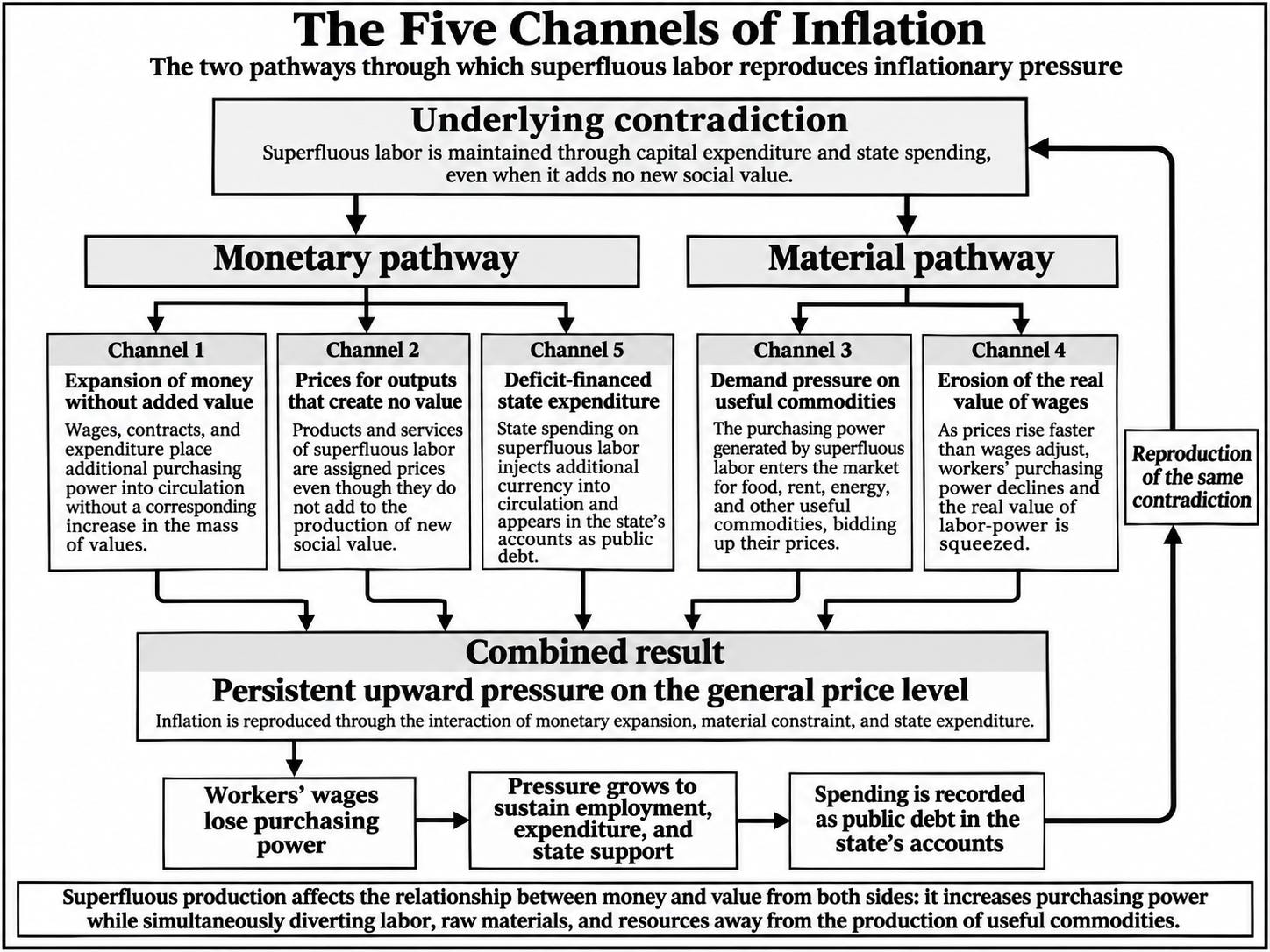
The five channels do not operate independently but form a single process that begins in production and ultimately produces a sustained rise in the general price level. It starts with labor being expended on production that creates no socially useful output, after which the state purchases the product of that labor by issuing currency through its spending. That money immediately enters circulation even though the total mass of values remains unchanged, while prices are nevertheless assigned to the resulting output, allowing the new purchasing power to circulate alongside commodities that do possess use-value. As this money enters the economy, it bids up the prices of useful commodities, while the diversion of labor, raw materials, and other resources into superfluous production further restricts the resources available for producing them. Workers are then squeezed from both sides, as rising prices erode the purchasing power of wages that adjust more slowly, while the extension of working hours increases the supply of labor-time available for sale and weakens their bargaining position. The spending is recorded in the state’s accounts as public debt, but that debt is simply the financial counterpart of currency already placed into circulation without a corresponding increase in the mass of value. Throughout this process, the quantity of money grows relative to the value represented by the commodities available, and when these same conditions are reproduced year after year, their cumulative effect is a persistent, long-term rise in the general price level / secular inflation.
Every advance in technology, machinery, and the organization of production allows society to produce the same quantity of goods with fewer hours of living labor, steadily reducing the amount of time actually required to reproduce its material wealth. Under capitalism, however, this growing productive capacity does not translate into a corresponding reduction of the working day because capital remains dependent on extracting surplus-value through the employment of living labor and the appropriation of unpaid labor-time. Capital must therefore preserve the expenditure of labor even as an increasing portion of it becomes unnecessary for material production, preventing the time saved through higher productivity from becoming available as free time. Instead, workers continue to be employed and paid wages while an increasing share of their working hours contributes nothing to the creation of new social value, producing a growing mass of superfluous labor-time that must nevertheless be maintained if the wage relation is to continue. As this contradiction intensifies and absolute overproduction of capital develops, maintaining employment increasingly takes precedence over the actual requirements of material production, compelling the system to sustain labor that can no longer contribute to the expansion of value.
Under these conditions, the state becomes the principal means through which this otherwise unnecessary labor is financed and kept in employment as part of the continuing reproduction of capitalist production.
The same contradiction reveals why explanations that begin with money and exchange cannot get to the root of persistent inflation, since the Austrian approach may correctly identify the state as the source of additional currency but treats the expansion of the money supply as an independent cause rather than examining the conditions that continually compel the state to issue more of it. It never addresses why this monetary expansion has become necessary in the first place, namely that once absolute overproduction of capital makes further accumulation incapable of generating a corresponding expansion of surplus-value, capital can no longer sustain the existing level of production and employment through its own valorization. The monetary theory of value approaches the problem from the opposite direction, but arrives at a similarly inadequate explanation because it locates the constitution of value in the monetary relation itself, making the state’s purchase of ammunition or surplus crops appear to validate the labor expended in their production simply because the commodities have been sold and a price has been paid. Despite their opposing theoretical premises, neither approach can explain why the continuous monetization of labor that produces no new value has become a structural necessity rather than merely the consequence of misguided monetary policy, because both fail to account for the underlying limits imposed by absolute overproduction of capital. This condition emerges when additional capital can no longer expand the production of surplus-value, so that the continued employment of labor-power increases the total mass of capital without producing a corresponding increase in the mass of values, leaving the same or a smaller quantity of surplus-value to be measured against an ever-larger capital and consequently driving down the rate of profit. Under these conditions, state expenditure does not simply facilitate the realization of value already created through production, but increasingly becomes the means through which labor that can no longer be productively employed by capital is kept at work, and the reproduction of the capitalist system is sustained.
The historical development of the twentieth century should be understood through this same contradiction, since by the early 1930s, rising productivity had substantially reduced the amount of living labor necessary to produce a given mass of commodities without producing a corresponding reduction in the length of the working day. This left an increasingly wide gap between the labor society needed to reproduce its material wealth and the labor capitalism continued to employ. Within this, the gold standard became an obstacle to sustaining this growing mass of superfluous labor because its connection to commodity money imposed limits on the state’s ability to finance activities that could no longer be maintained through the ordinary reproduction of capital. Once the state gained the ability to issue inconvertible fiat currency, it could purchase the products of this labor without facing the same constraints imposed by a monetary system tied to commodity money. This allowed otherwise unnecessary production to continue through government expenditure; as the Agricultural Adjustment Act shows, the state paid for the destruction of crops and livestock that had no market demand, giving a monetary form to production that contributed nothing to usable wealth.
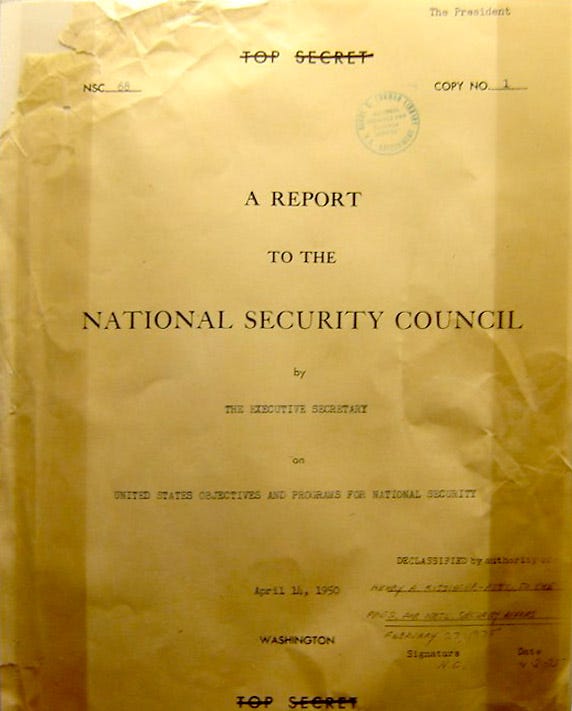
This arrangement was eventually institutionalized on a permanent basis through the expansion of military spending. The issuance of NSC-68 in 1950 called for a massive increase in defense expenditure even during peacetime and helped establish a permanent military economy whose continued reproduction no longer depended on the market demonstrating that its output was productively creating value. Cost-plus contracts guaranteed private contractors reimbursement for their expenses along with an additional fee so that military production could continue through government expenditure regardless of whether the commodities produced contributed to the creation of new social value, and therefore, the circuit of capital increasingly took the form M–C–M(state) rather than M–C–M′. Superfluous labor consequently became incorporated into the cost structure of military production and was reproduced with every successive cycle of government spending. Military manufacturing and the administrative apparatus surrounding it absorbed an increasing share of total economic activity while introducing additional currency into circulation without a corresponding increase in the mass of values. At the same time, this expenditure diverted labor and raw materials away from the production of useful commodities. The expansion of this sector intensified the contradiction from both sides by generating additional purchasing power through the payment of wages for labor that produced no new value while consuming material resources that could otherwise have been used to expand the production of socially useful goods.
Conclusion
The practical conclusion follows directly from this contradiction, because so long as the social working day remains longer than the time actually required to produce society’s material wealth, a portion of the labor performed will remain superfluous. The state will continue to absorb this excess through its spending by creating additional currency and introducing it into circulation without a corresponding increase in the mass of values. In my opinion, the only measure that directly confronts this problem is reducing working hours themselves. Through a shorter working day, society can let productivity advances reduce the time people must spend working, rather than continuing to preserve the labor expenditure that its own productive development has made unnecessary. If it is true that the majority of work exists in excess and superfluidity, and this is the source of inflation, then logically the reduction of this labor could open up the possibility of reducing working hours throughout the entire economy, thus lowering prices, and opening the possibility of rational planning of the economy and its newly freed up resources.
SOURCES
[1] Shostak, Frank. “What ‘Inflation’ Really Means.” Mises Wire, 3 Nov. 2021,
[2] Karl Marx, Capital: A Critique of Political Economy, Volume I, trans. Samuel Moore and Edward Aveling, ed. Friedrich Engels (Moscow: Progress Publishers, 1887),
[3] Rev Laskaris, “The Political Economy of Barbarism,” RTSG, April 12, 2026,
[4] U.S. Department of Commerce. Purchased in America 2023. January 2025,
[5] “United States Military Spending,” Defense Budget, accessed November 19, 2026,
[6] “United States,” MilitarySpend, accessed November 19, 2026
[7] Aerospace Industries Association. “Industry Impact.” Aerospace Industries Association,
[8] Aerospace Industries Association. “2026 AIA Facts & Figures: U.S. Aerospace & Defense Industry Leads the World with $1 Trillion in Sales.
[9] Gregory Wischer, Morgan Bazilian, and Macdonald Amoah, “As America’s Military Rearms, It Needs Minerals—and Lots of Them,” Modern War Institute at West Point, November 29, 2023,
[10] U.S. House of Representatives, Committee on Natural Resources, Subcommittee on Energy and Mineral Resources, “Powering the 21st Century with American Copper,” April 29, 2026, Questions from Representative Wittman and others for Dr. Daniel Yergin,
[11] Gregory Wischer, Morgan Bazilian, and Macdonald Amoah, “As America’s Military Rearms, It Needs Minerals—and Lots of Them,” Modern War Institute at West Point, November 29, 2023,
[12] Vittoria Dicandia, “Trends in Manufacturing in the United States,” Federal Reserve Bank of Cleveland, Economic Commentary, September 21, 2026,
[13] Andrew Rechenberg, “U.S. Manufacturing’s Shrinking Share of GDP and How to Catch Up,” Coalition for a Prosperous America, November 8, 2024,
Damn good, Rev!